BRITAIN BENEATH · GUIDE · 8 OCTOBER 2026
Herne Windmill: They Raised the Building to Reach More Wind
In 1856, workers lifted Herne’s wooden mill and built two brick storeys beneath it. The owners believed nearby orchards were blocking wind from the sails.
Based on published records and visitor information. We have not visited these places.
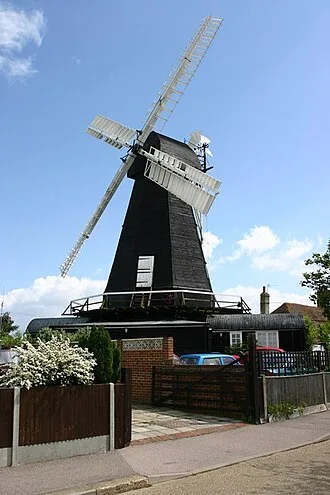
Herne Windmill, photographed in May 2005.
Herne Windmill by Jim Woodward-Nutt · CC BY-SA 2.0. Wikimedia rendition converted to WebP and resized where needed; no cropping or retouching. Photographic derivatives remain under the stated licence.

When trees were blamed for lost wind
Workers raised Herne’s wooden mill in 1856 and built two brick storeys underneath. The Friends of Herne Mill explain why: nearby orchards were thought to obstruct the wind reaching the sails.
Wind turned the sails, which drove the milling machinery. Raising the building was intended to put the sails above more of the obstruction caused by the trees. Rather than replace the wooden body, workers supported it on a taller base. The two brick storeys are evidence of that alteration.
Millers later added engines to provide power when wind was insufficient. The building and its equipment therefore changed in stages. Its present form does not all date from the year it was first built.
- History of Herne Mill ↗ · reviewed 2026-10-07
- Historic England — Herne Windmill ↗ · reviewed 2026-09-22
- Kent County Council — Herne mill visitor information ↗ · reviewed 2026-10-07
Engines helped too
The operator’s history records a steam engine, followed by other engines. These provided power when the wind was insufficient to drive the mill’s machinery.
The earliest date is disputed. Historic England gives 1781. The operator and county council use 1789. The Friends say 1789 is carved into a wooden post, but also explain that the building date and builder are uncertain.
The carved year is one piece of evidence. It does not date every part of a building later lifted and altered. We give the conflicting dates because the sources have not settled the year of construction.
Later repairs and restoration followed the decline of commercial milling. Volunteers now care for the mill as heritage. Opening it to visitors and running its machinery are separate arrangements.
- History of Herne Mill ↗ · reviewed 2026-10-07
- Historic England — Herne Windmill ↗ · reviewed 2026-09-22
- Kent County Council — Herne mill visitor information ↗ · reviewed 2026-10-07
Checking the season and stairs
The Friends list selected opening days, normally from Easter to the end of September. Sessions depend on volunteers. This is more specific than the council’s general Sunday schedule.
When this guide was published in October 2026, the usual season had ended. Check confirmed dates or ask about an appointment before travelling. Do not arrive expecting a tour because a general page mentions Sundays.
The council describes ground-floor access and displays in the Wootton Room. That does not make all upper floors step-free. Ask which areas you can reach. Follow guides’ advice near machines, and do not assume the sails will turn.
The two brick storeys beneath the wooden body are evidence of the 1856 work. Knowing why they were added helps explain the taller shape of the mill today.
- Visit Herne Mill ↗ · reviewed 2026-10-07
- Kent County Council — Herne mill visitor information ↗ · reviewed 2026-10-07
Sources and further reading
Based on the linked official heritage records and visitor pages. We have not visited or confirmed access directly. Older descriptions and photos may not reflect today’s condition. Check current official visitor advice before travelling. The 1 place records below give more information.
- Herne Windmill — 1084984
You can follow the links to read the original sources. Sources and permissions.