BRITAIN BENEATH · GUIDE · 8 OCTOBER 2026
Folkestone Harbour: Walk Across the Old Boat-Train Bridge
The old railway crossing now leads walkers through Folkestone’s restored harbour station. Its swing bridge once opened a gap for ships between train journeys.
Based on published records and visitor information. We have not visited these places.
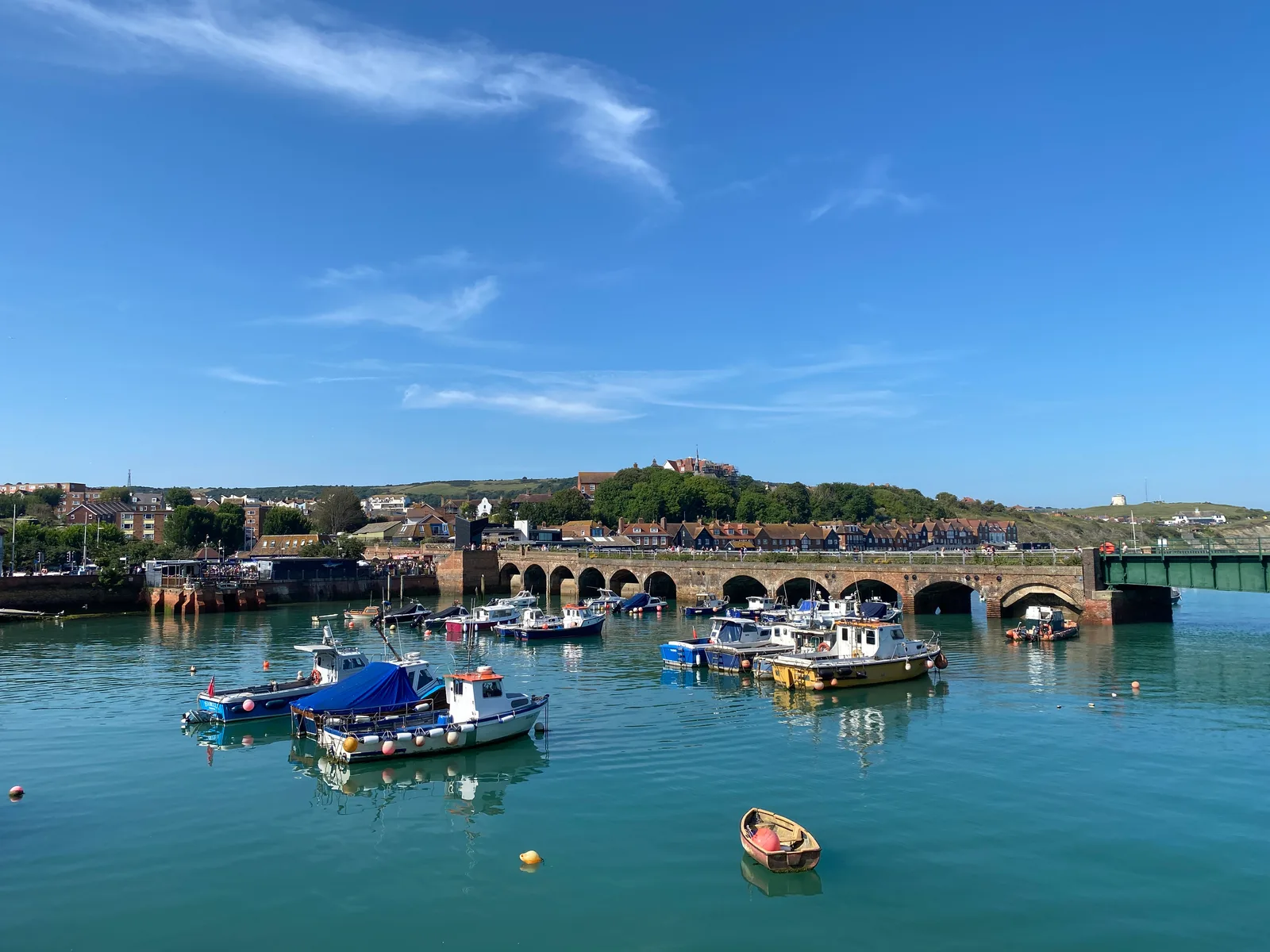
Folkestone Harbour’s brick railway bridge and steel swing bridge in June 2025. The old train route is now a walking route.
Inner harbour and viaduct by Alan Hughes · CC BY-SA 2.0. Resized and converted to WebP for faster loading; no cropping. Adapted image files remain under CC BY-SA 2.0.

Bringing trains to the ships
Walkers cross Folkestone Harbour on the route once used by trains taking passengers towards ships for France. The path passes through the restored station, where rails and platforms remain beside the route towards the Harbour Arm.
The South Eastern Railway bought the harbour in 1843 and extended its line towards the water. William Cubitt’s thirteen brick arches carried the tracks across the inner harbour.
A fixed crossing could not occupy the whole channel: ships still needed a way through. By 1847, a swing span completed the railway route. The movable part of the bridge turned aside to leave a gap for ships, then returned to carry trains. Later replacement bridges kept that moving section.
- Folkestone Harbour Viaduct and Swing Bridge (1404114) ↗ · reviewed 2026-09-28
- The Station: design and restoration ↗ · reviewed 2026-09-28
A bridge that moved aside
Trains needed to cross the harbour, but ships still needed a gap. By 1847, a swing bridge completed the route to the southern harbour arm. It could turn aside for water traffic, then return for trains.
As the railway began using heavier trains, replacement bridges followed in 1893 and 1930. George Ellson designed the current steel span for the Southern Railway in 1930. It stands on brickwork from the 1893 bridge.
The brickwork and steel belong to different phases of one connection. Historic England lists the arches and swing bridge together at Grade II. They preserve the route built to connect rail and sea journeys.
- Folkestone Harbour Viaduct and Swing Bridge (1404114) ↗ · reviewed 2026-09-28
The railway became a walking route
The harbour carried more than holiday travellers. Historic England records a major role in moving people and supplies between Britain and Europe during the First World War.
The harbour branch declined and officially closed in 2014. The owners restored the station and platforms, reopening them as public space in 2018. Rails remain beside the landscaped walking route.
- Folkestone Harbour Viaduct and Swing Bridge (1404114) ↗ · reviewed 2026-09-28
- The Station: design and restoration ↗ · reviewed 2026-09-28
Check the harbour’s visiting rules
The Harbour Arm operator describes the bridge as a walking approach to the restored station and Harbour Arm. The harbour is privately owned. Public visits are allowed, but that permission can be limited by weather, events or works.
On 28 September 2026, the operator said pedestrian access over the bridge remained open during a road diversion after a nearby fire. That dated notice is not a promise of today’s route. Check the latest update.
The operator gives accessible routes between harbour areas. It does not recommend the beach boardwalk for wheelchairs or mobility scooters. Check the route you need. Keep to marked paths and respect barriers by water and structures.
We have not walked or inspected the route. Follow current visitor advice. Where the path is open, you can cross the old bridge and walk through the station that once connected trains with ships for France.
- Folkestone Harbour Arm: plan your visit ↗ · reviewed 2026-09-28
- Plan your trip: September 2026 access update ↗ · reviewed 2026-09-28
Sources and further reading
Historic England’s record, the harbour owner’s history and Harbour Arm notices were checked on 28 September 2026. We have not visited or confirmed visitor arrangements directly with staff. The road diversion and bridge access notice describe that date. Check the latest notices for today’s opening and step-free routes. Photo rights are credited beside the image. The 1 place records below give more information.
You can follow the links to read the original sources. Sources and permissions.