BRITAIN BENEATH · GUIDE · 8 OCTOBER 2026
Armley Mills: The Textile Museum With Arches From a Sewage Works
Two arches from a shed at Esholt sewage works were taken apart and rebuilt at Armley Mills around 1985. They joined a museum whose textile buildings were much older.
Based on published records and visitor information. We have not visited these places.
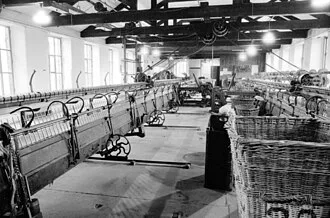
Textile machines at Leeds Industrial Museum in December 1983. This old photo does not show the moved engine shed or today’s displays.
Armley Mills by Chris Allen · CC BY-SA 2.0. Wikimedia rendition converted to WebP and resized where needed; no cropping or retouching. Photographic derivatives remain under the stated licence.

A shed brought from elsewhere
Two arches at Armley Mills came from a shed at Esholt sewage works. Built around 1895, they were moved and rebuilt at Armley around 1985, where they form part of an attached engine shed.
The drying house beside it was used in the mill’s cloth-making work. Historic England dates it to 1809 and links it to Benjamin Gott. Its origins are therefore quite different from those of the relocated arches.
The museum preserves both the mill’s own workplace and parts saved from elsewhere. The arches record that later preservation work. They were not part of the textile mill’s original engine shed.
- Historic England — Drying House Range And Attached Engine Shed At Armley Mills ↗ · reviewed 2026-09-13
- The Textile Industry and the Self-Acting Mule ↗ · reviewed 2026-10-07
Cloth, machines and fire risk
Historic England describes cast-iron roof supports intended to reduce fire risk in the mill buildings. It also records a gas plant at the western end. The buildings housed both textile work and equipment serving the site.
A self-acting spinning mule drew out fibres and twisted them into yarn. Despite the name, people still had to operate and maintain it. Leeds Museums explains that work alongside the textile machinery.
The Esholt arches came from a different workplace. Rebuilding them at the museum saved parts of that shed, but does not mean they belonged to the mill’s original textile operation.
- Historic England — Drying House Range And Attached Engine Shed At Armley Mills ↗ · reviewed 2026-09-13
- The Textile Industry and the Self-Acting Mule ↗ · reviewed 2026-10-07
What is closed during the works
Leeds Industrial Museum offers visits, but its current notice closes the engine shed and locomotives during building and maintenance work. The main car park is also closed for sewage works, expected into spring 2027. We rechecked both notices on 7 October 2026.
Use the visitor and access pages to plan how to arrive and which galleries to see. A museum ticket does not open a closed building. If the drying house is your main reason for coming, ask which parts you can reach. We have not confirmed access to every part of the listed range.
Plan around the museum’s current openings. The relocated arches belong to its history, but the engine-shed closure means you should not assume you can enter that building on a visit.
- Leeds Museums and Galleries — Leeds Industrial Museum ↗ · reviewed 2026-10-07
Sources and further reading
Based on the linked official heritage records and visitor pages. We have not visited or confirmed access directly. Older descriptions and photos may not reflect today’s condition. Check current official visitor advice before travelling. The 1 place records below give more information.
You can follow the links to read the original sources. Sources and permissions.