BRITAIN BENEATH · GUIDE · 8 OCTOBER 2026
Stanley Ferry: Carrying a Canal Over a River in an Iron Trough
An iron trough carries canal boats above the River Calder at Stanley Ferry. Nearby workshops still make the wooden gates needed by working canals.
Based on published records and visitor information. We have not visited these places.
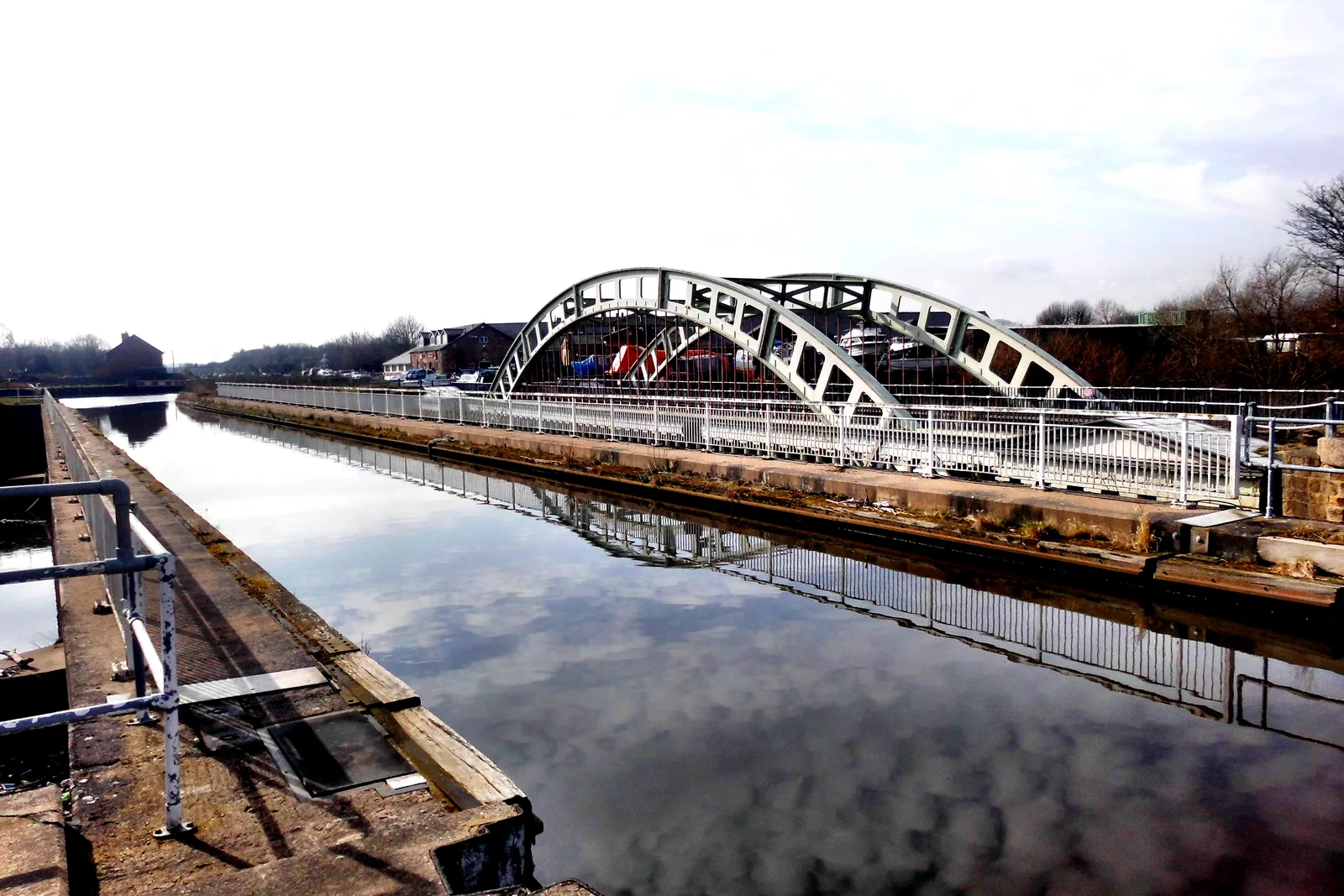
Stanley Ferry’s iron aqueduct beside the plainer canal crossing on 9 March 2018. This photo does not confirm today’s condition or access.
Stanley Ferry Aqueducts by derek dye · CC BY-SA 2.0. Resized and converted to WebP, no cropping. Both derivatives remain available under CC BY-SA 2.0.

A canal above a river
Stanley Ferry carries canal boats over a river in an iron trough. This section of the Aire and Calder Navigation, a canal route, crosses above the River Calder, with canal water held clear of the river below.
Near Wakefield, the older aqueduct’s large iron arches support its water channel. In derek dye’s photograph from March 2018, it stands beside a plainer canal crossing. The older structure was built in 1837–1839 to George Leather junior’s design.
Iron did not become the usual choice for every canal bridge. Stanley Ferry is a surviving example of the less common approach. Nearby workshops supply another part of canal engineering: new gates for canal locks. These gates hold back water while boats are raised or lowered between canal levels.
- Stanley Ferry Aqueducts, Geograph 5701945 ↗ · reviewed 2026-10-07
- Stanley Ferry ↗ · reviewed 2026-10-07
- Historic England — Stanley Ferry listed aqueduct ↗ · reviewed 2026-10-07
- A cast-iron legacy ↗ · reviewed 2026-10-07
- Innovation at our lock gate workshops ↗ · reviewed 2026-10-07
- Stanley Ferry Workshop Open Day ↗ · reviewed 2026-10-07
Building with iron
George Leather junior designed the older crossing in 1834. It was built in 1837–1839. An iron trough holds the water. The arches above support it, and stone supports stand at each end.
The builders decorated the crossing too. Small grooved columns run along the trough’s sides, and Classical-style details mark the end supports. Historic England describes both the practical structure and its decoration.
Coal transport shaped the area around it. Experience Wakefield describes pits, wagons and barges at Stanley Ferry. The crossing belonged to that working landscape, not a place set apart from industry.
- Historic England — Stanley Ferry listed aqueduct ↗ · reviewed 2026-10-07
- Stanley Heritage Trail ↗ · reviewed 2026-10-07
An idea that stayed unusual
Other canal builders had tried iron before Stanley Ferry. Canal & River Trust traces early designs by Benjamin Outram and Thomas Telford. Iron plates could form the water channel itself, instead of a stone structure.
Canal & River Trust links the limited use of iron to cautious canal companies and a shortage of skilled ironworkers. Many builders continued using brick and stone.
- A cast-iron legacy ↗ · reviewed 2026-10-07
Making new gates for old canals
The nearby workshops still serve the canals. Canal & River Trust makes lock gates at Stanley Ferry and Bradley. Its 2023 account says gates usually last about twenty-five years, so new parts are always needed.
Each new gate has to fit its particular lock. Carpenters, engineers and heritage staff have worked on faster production while keeping the familiar designs. Their work supplies parts that old waterways still need.
The workshops offered an open day on 12 September 2026. That date has passed. It was a special opening, not permission to enter on any other day. Check for a new listed event rather than walking into the work area.
- Innovation at our lock gate workshops ↗ · reviewed 2026-10-07
- Stanley Ferry Workshop Open Day ↗ · reviewed 2026-10-07
Views from public paths
Experience Wakefield gives waterside walks and the Stanley Heritage Trail. Its Waterways & Industry section is listed as 2.6 miles, within a 6.7-mile trail. Use current route details and signs.
An older Park Hill leaflet says its directions were correct in September 2016. A newer download address does not make the route newly checked. We have not walked the routes or checked surfaces, closures or step-free access.
Stay on public paths and respect barriers by the water and workshops. We have not confirmed a public crossing on the iron aqueduct. Use the listed trails for views, and wait for an advertised event if you want to visit the gate-making workshops.
- Stanley Ferry ↗ · reviewed 2026-10-07
- Stanley Heritage Trail ↗ · reviewed 2026-10-07
- Experience Wakefield — Stanley Ferry walk ↗ · reviewed 2026-10-07
- Historic England — Stanley Ferry listed aqueduct ↗ · reviewed 2026-10-07
Sources and further reading
Historic England, Canal & River Trust and Wakefield visitor sources were checked on 7 October 2026. The older Park Hill leaflet describes September 2016 routes. Promoting a trail is not the same as inspecting it. The workshop open day on 12 September 2026 has passed. We have not visited, checked with staff, inspected current surfaces or confirmed a public crossing on the iron aqueduct. The 2018 photo has checked CC BY-SA 2.0 rights. Sources disagree on replacement dates. We do not use those dates or claim a certain world first. The 1 place records below give more information.
- Stanley Ferry aqueduct — 1005773
You can follow the links to read the original sources. Sources and permissions.