BRITAIN BENEATH · GUIDE · 8 OCTOBER 2026
Marple’s Canal: The Aqueduct and Sixteen Locks That Moved Limestone
Derbyshire limestone crossed the Goyt by aqueduct and travelled between canal levels through sixteen locks. Marple’s builders needed both structures to complete the route towards Manchester.
Based on published records and visitor information. We have not visited these places.
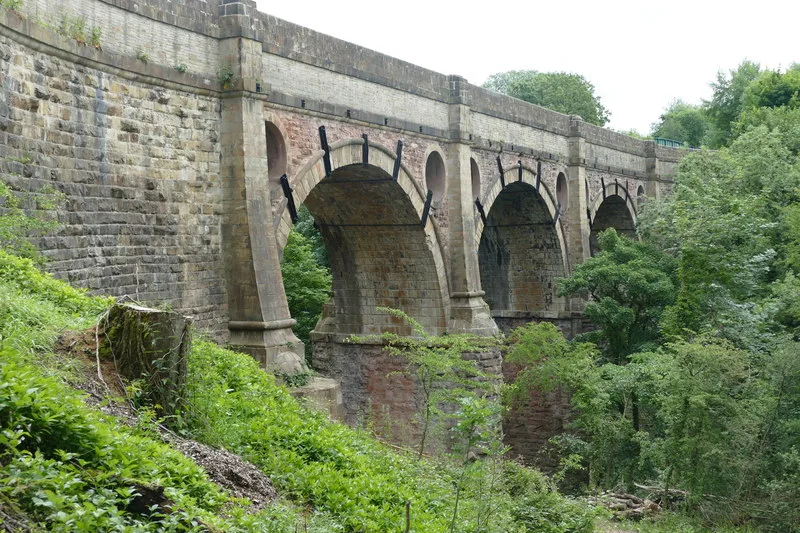
Marple Aqueduct, photographed in June 2015.
Marple Aqueduct by Graham Hogg · CC BY-SA 2.0. Wikimedia rendition converted to WebP and resized where needed; no cropping or retouching. Photographic derivatives remain under the stated licence.

Limestone had to reach Manchester
Limestone from Derbyshire had to cross uneven ground on its way towards Manchester. At Marple, canal builders carried boats over the River Goyt on a stone aqueduct and used sixteen locks to move them between different water levels.
Benjamin Outram’s aqueduct held the canal high above the river. Farther along, each lock enclosed a boat while water was added or released. The changing water level raised or lowered the boat so it could continue.
The canal opened in 1800, according to Canal & River Trust, but the sixteen locks were not completed until 1804. The aqueduct already took boats over the river. The locks supplied the missing way to move them between the canal’s higher and lower sections.
- Canal & River Trust — Peak Forest Canal history ↗ · reviewed 2026-10-07
- Canal & River Trust — Marple Locks ↗ · reviewed 2026-10-07
A bridge and sixteen locks
Outram’s stone aqueduct holds a channel of canal water above the river. It lets boats stay at the canal’s level as they cross the valley. A path alongside the water gave people working the boats a way across too.
A higher railway bridge stands beside it. The two structures carry different routes across the same valley. You can see the railway bridge from the canal path, but its deck is not a public walking route.
Inside a lock, the crew closes the gates around a boat. Adding or releasing water raises or lowers it to the next canal level. The next gates can then open. Repeating this through the sixteen locks takes a boat up or down the slope.
- Canal & River Trust — Peak Forest Canal history ↗ · reviewed 2026-10-07
- Canal & River Trust — Marple Locks ↗ · reviewed 2026-10-07
Following the canal path
Canal & River Trust gives visitor details for Marple Locks and the aqueduct. It describes the towpath as open. Check latest notices for temporary closures before travelling.
Marple station can be a useful start for reaching the canal. Use the Trust’s directions to find the public route. The map point marks the historic structure, not a complete walking route or entrance.
Give boat crews room near lock gates. Take care at lock edges and by water, especially with children. We have not confirmed a step-free route. Stay on the public towpath and signed paths. Do not climb railway structures or enter machines.
- Canal & River Trust — Marple Locks ↗ · reviewed 2026-10-07
Sources and further reading
Based on the linked official heritage records and visitor pages. We have not visited or confirmed access directly. Older descriptions and photos may not reflect today’s condition. Check current official visitor advice before travelling. The 1 place records below give more information.
- Marple aqueduct — 1001954
You can follow the links to read the original sources. Sources and permissions.