BRITAIN BENEATH · GUIDE · 8 OCTOBER 2026
Scotland’s Union Canal: From Coal Boats to the Falkirk Wheel
The Union Canal carried coal towards Edinburgh, closed to boats in 1965 and reopened in 2001. The Falkirk Wheel then restored its link with another canal.
Based on published records and visitor information. We have not visited these places.
AI-generated illustration
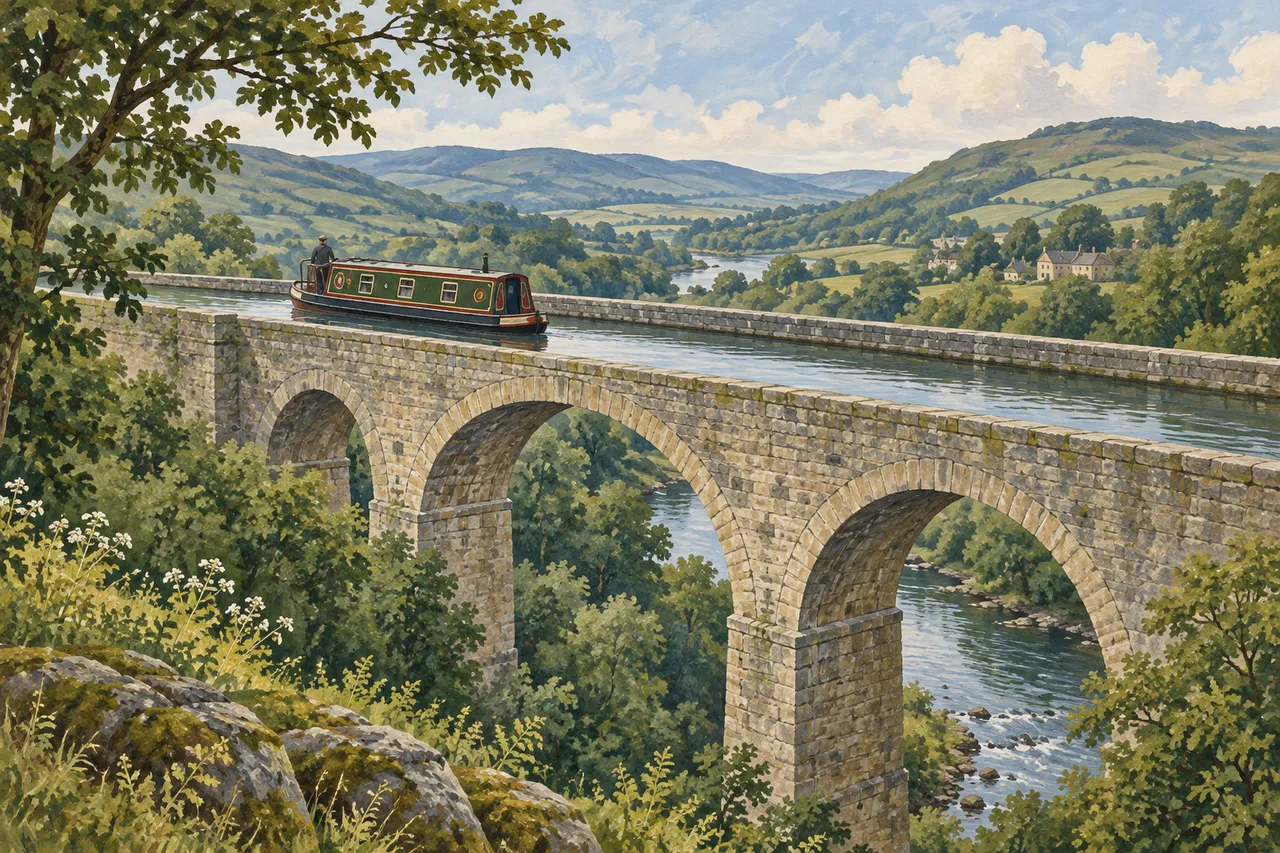
An imagined aqueduct shows a canal crossing a valley. The bridge and landscape are not copies of a specific Scottish site.
AI-generated for Britain Beneath · 2026-09-27. Resized and converted to WebP for faster loading; no cropping.
A canal for coal
The Union Canal reopened to boats in 2001 after closing in 1965. A year later, the Falkirk Wheel linked it with the Forth & Clyde Canal, lifting boats between their different water levels.
The route was much older than the Wheel. It opened in 1822 to bring cheaper coal from the west towards Edinburgh. Builders carried sections of canal across valleys on bridges called aqueducts. Where higher ground blocked the route, they cut through it. This allowed boats to stay at the canal’s level.
Those earlier structures still form part of the route. At Ratho, boats can stop beside the canal. At Almond, an aqueduct carries them above a river. The feeder channel nearby has a different job: supplying the canal with water.
- Scottish Canals — Union Canal history and heritage ↗ · reviewed 2026-09-13
- Scottish Canals — Falkirk Wheel boat trips ↗ · reviewed 2026-09-23
- Scottish Canals — Falkirk Wheel navigation ↗ · reviewed 2026-09-13
A place to repair boats
At Ratho Basin, a dry dock let workers repair boats away from the main channel. They could drain the dock and reach parts of the boat normally under water.
Scottish Canals still lists visitor moorings, water and waste services here. The basin continues to serve canal users. You can see it from the public towpath. Keep the path clear and do not enter boats or working areas without permission.
- Scottish Canals — Union Canal facilities ↗ · reviewed 2026-09-13
- Scottish Canals — visiting the Union Canal ↗ · reviewed 2026-09-13
Keeping boats above the river
At Almond Aqueduct, boats cross the River Almond in a channel of water carried on a bridge. They stay at the canal’s level instead of descending to the river below.
Scottish Canals’ maps show the crossing. The journey times on those maps are for boats, not walkers. Check current path advice before setting out.
The nearby Almond Feeder Aqueduct is a different structure. It helps supply water and has different access rules.
- Scottish Canals — Union Canal navigation maps ↗ · reviewed 2026-09-13
- Scottish Canals — visiting the Union Canal ↗ · reviewed 2026-09-13
- Scottish Canals — Almond Feeder Aqueduct walkway closure ↗ · reviewed 2026-09-23
Bringing water to the canal
The Almond Feeder supplies water to the canal along a channel about three kilometres long. It opened in 1822. Scottish Canals describes four stone tunnels along its route.
These tunnels carry water, not boats or visitors. Checks after ground movement were completed in 2019. Repairs and inspections are part of keeping an old canal working.
On 23 September 2026, the operator said the walkway on the smaller feeder aqueduct was closed because of concerns about its iron structure. It gave an alternative bridge nearby. That notice did not concern the main Almond Aqueduct.
- Scottish Canals — Almond Feeder works ↗ · reviewed 2026-09-13
- Scottish Canals — Almond Feeder Aqueduct walkway closure ↗ · reviewed 2026-09-23
The lift that joined two canals
Almost two centuries after the Union Canal opened, the Falkirk Wheel restored its link to the Forth & Clyde Canal. The rotating lift opened in 2002 and carries boats between the two canals’ different water levels.
The operator’s original boat tour rides the Wheel, goes through Roughcastle Tunnel and returns. Check the exact trip and dates before booking. Roughcastle is not the older Falkirk Tunnel. A tour through one does not give access to the other.
- Scottish Canals — Union Canal history and heritage ↗ · reviewed 2026-09-13
- Scottish Canals — Falkirk Wheel boat trips ↗ · reviewed 2026-09-23
- Scottish Canals — Falkirk Wheel navigation ↗ · reviewed 2026-09-13
Planning your trip
Ratho offers a canalside visit. A Wheel tour offers a lift and tunnel trip. They are separate starting points, not nearby stops on a short walk.
Check the current works list. A September notice gave a Park Farm Bridge diversion until 2 October and possible local diversions at the Wheel until 19 October. It did not expect the Wheel works to close the main path or canal. Those dates do not prove today’s conditions. We have not checked a full route or step-free access.
Boaters and paddlers have separate rules. Kayak users should contact the Basin Controller about the Wheel or Roughcastle.
- Scottish Canals — visiting the Union Canal ↗ · reviewed 2026-09-13
- Scottish Canals — Falkirk Wheel boat trips ↗ · reviewed 2026-09-23
- Scottish Canals — Falkirk Wheel navigation ↗ · reviewed 2026-09-13
- Scottish Canals — 2026–27 stoppages programme ↗ · reviewed 2026-09-23
Sources and further reading
Written from the linked sources. Visitor and access notices were rechecked on 23 September 2026; some historical source material was checked earlier. We have not visited or confirmed visitor arrangements directly with staff. Check the official notices again before travelling. The 2 place records below give more information.
- Union Canal, Ratho Canal Basin — 106012
- Union Canal, Roughcastle Tunnel — 279405
You can follow the links to read the original sources. Sources and permissions.