BRITAIN BENEATH · GUIDE · 8 OCTOBER 2026
Barton Aqueduct: The Swing Bridge and the Stone Arch Saved Beside It
Barton’s aqueduct carries the Bridgewater Canal above the Manchester Ship Canal in an iron trough. The bridge can turn aside for ships. Nearby, a rebuilt stone arch preserves part of the crossing it replaced.
Based on published records and visitor information. We have not visited these places.
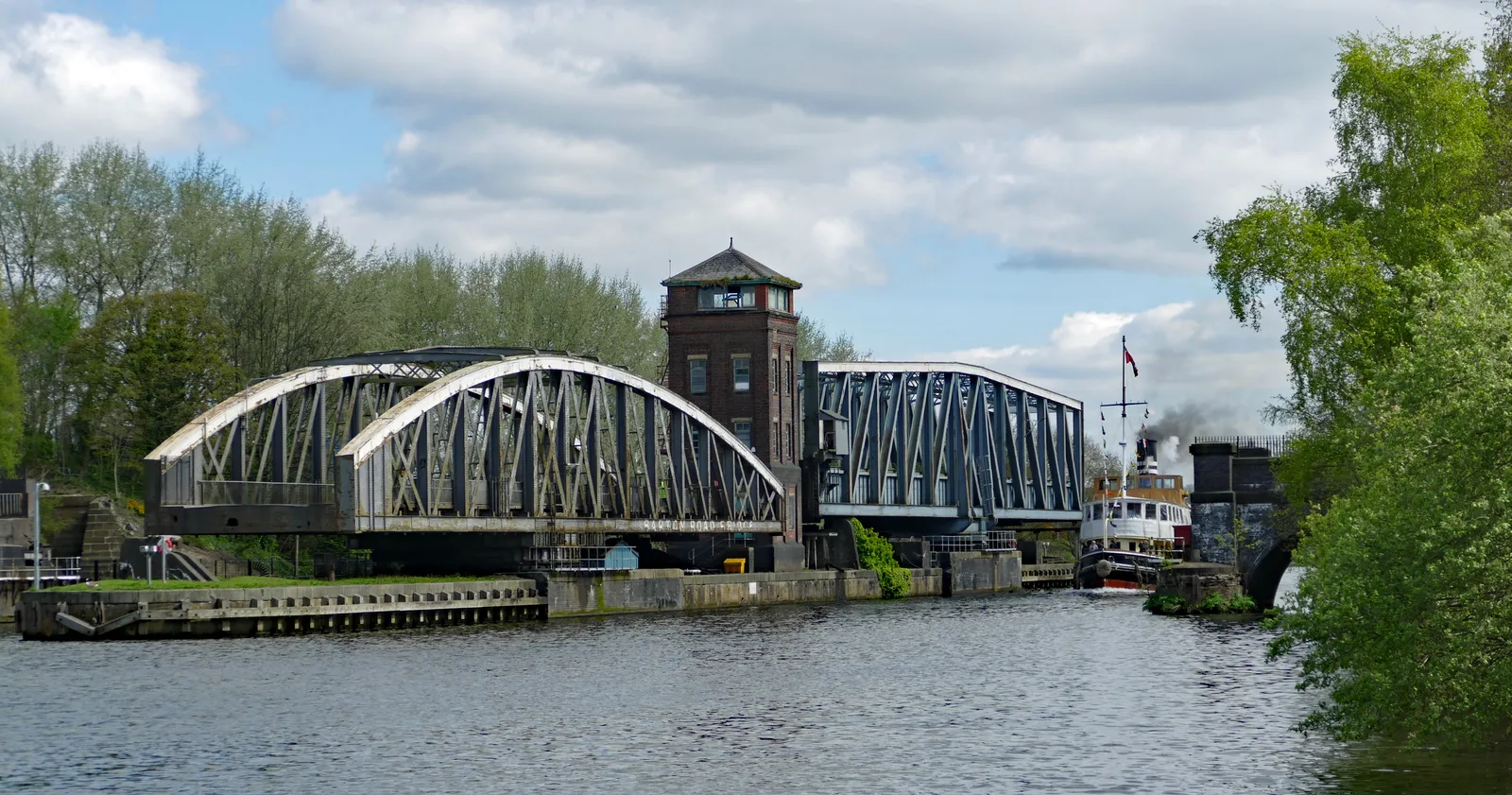
Barton’s road bridge and canal aqueduct turned aside for the Daniel Adamson in April 2017. This photo does not give today’s access or swing times.
Barton Road Swing Bridge and Barton Aqueduct open for the Daniel Adamson by Andrew (ARG_Flickr) · CC BY 2.0. Resized and converted to WebP; no cropping.

Making room for ships
Workers saved part of Barton’s old aqueduct by taking it apart. During construction of the Manchester Ship Canal, they dismantled one stone face of an arch and rebuilt it nearby as a memorial in 1894.
The arch had belonged to James Brindley’s fixed crossing, opened in 1761. That aqueduct carried the Bridgewater Canal above Barton Lane and the River Irwell, letting coal boats continue from Worsley towards Manchester at the canal’s level.
The Manchester Ship Canal needed a clear route for ships where the old stone crossing stood. Most of that aqueduct was removed. Its replacement carried the Bridgewater Canal in an iron trough on a bridge that could turn aside. The rebuilt stone arch, surviving approach and moving bridge record different stages of the crossing’s history.
- Barton Lane Aqueduct Portal (NHLE 1462661) ↗ · reviewed 2026-09-30
- Bridgewater Canal’s Barton Aqueduct embankment and retaining walls (NHLE 1470478) ↗ · reviewed 2026-09-30
- Barton Bridge, Barton Aqueduct and Control Tower (NHLE 1356522) ↗ · reviewed 2026-09-30
The new bridge could swing
Around 1894, boats on the Bridgewater Canal began floating across the new aqueduct in its long iron trough. The trough holds the canal water above the Manchester Ship Canal. When a ship needs to pass below, the bridge turns, carrying the trough and its water out of the ship’s way.
A swing road bridge stood beside the aqueduct. It also turned to let ships pass, but carried vehicles instead of water. A control tower stood between the two bridges.
Historic England lists the bridges and tower together at Grade II*. The 2017 photo shows both bridges open for the steamboat Daniel Adamson. It records one working moment. Visitors cannot count on seeing a swing on any chosen day.
- Barton Bridge, Barton Aqueduct and Control Tower (NHLE 1356522) ↗ · reviewed 2026-09-30
The arch that was moved
One stone face from the old Barton Lane arch was saved. It came from Brindley’s crossing, though the dressed stone dates from the 1822–24 improvements.
Workers took it apart during the ship-canal works and rebuilt it nearby as a memorial in 1894. The inscription places its old position about fifteen yards east. Unlike the working swing bridge, this arch’s move was part of saving it.
It is not a complete aqueduct in its original place. The river arches are gone. A protected bank and retaining walls preserve another part, including the filled-in channel of the 1761 canal. Together they help explain the lost crossing.
- Barton Lane Aqueduct Portal (NHLE 1462661) ↗ · reviewed 2026-09-30
- Bridgewater Canal’s Barton Aqueduct embankment and retaining walls (NHLE 1470478) ↗ · reviewed 2026-09-30
Views from the park
Salford Council lists Barton Aqueduct Pocket Park on Old Barton Road as a public park with 24-hour pedestrian access. It gives views of the swing bridges and old remains. Use its public paths. We have not checked the exact view of every feature.
Do not climb the protected bank or enter the control tower and working areas. We have not confirmed a public towpath crossing of the aqueduct. A canal-company proposal from 2021 to restore one does not prove it opened.
- Barton Aqueduct Pocket Park ↗ · reviewed 2026-09-30
- Bridgewater Canal’s Barton Aqueduct embankment and retaining walls (NHLE 1470478) ↗ · reviewed 2026-09-30
- Barton Aqueduct Consultation ↗ · reviewed 2026-09-30
Sources and further reading
Historic England’s three records, Salford Council’s park page and the canal company’s walkway plan were checked on 30 September 2026. We have not visited or confirmed visitor arrangements directly with staff. The council confirms entry to the park, not the aqueduct, tower, arch or protected bank. The 2021 walkway proposal does not prove a route opened. Photo rights are credited beside the image. Barton’s bridge construction and movement were rechecked against Historic England’s record on 8 October 2026. This was not a new access check. The 3 place records below give more information.
- Barton Bridge, Barton Aqueduct And Control Tower — 1356522
- Barton Lane Aqueduct Portal — 1462661
- Bridgewater Canal's Barton Aqueduct embankment and retaining walls — 1470478
You can follow the links to read the original sources. Sources and permissions.