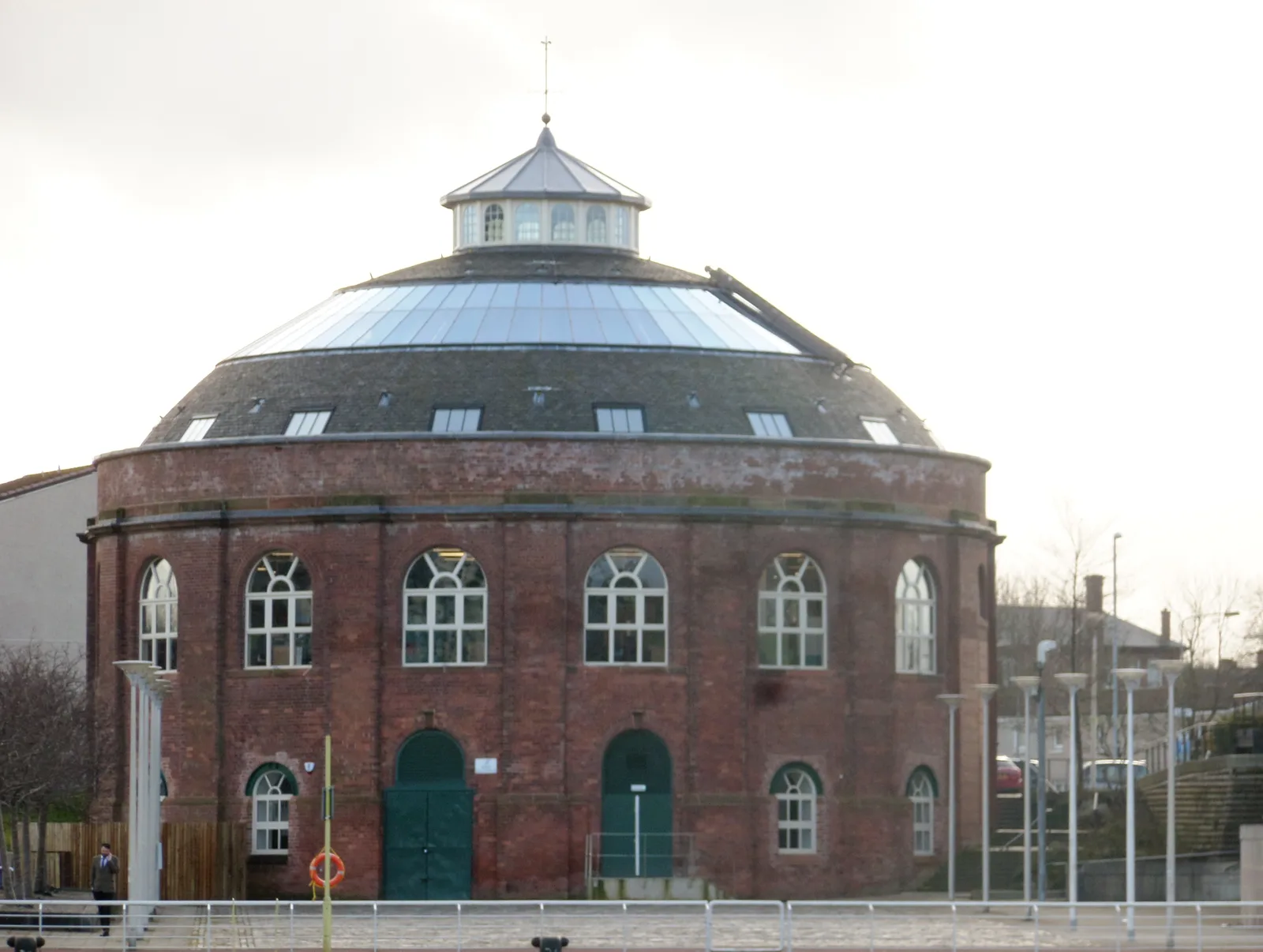

Exterior viewing only from lawful public space. The South Rotunda is the Malin Group’s office, and no public entry to the building or former harbour tunnels is established by our sources. Do not enter the premises, shaft or tunnel; check local public-route conditions before visiting.
Check the official visitor information ↗ · checked 2026-09-28
Use public paths and visitor areas. Do not enter unstaffed tunnels, shafts, railway land or restricted property.
Advice before you visitInformation checked 2026-09-28. Historic Environment Scotland listings, current occupant and restoration architect checked. No site visit or direct operator confirmation.
The building above a river crossing
The South Rotunda was built over a large shaft at the end of the Glasgow Harbour Tunnel. Historic Environment Scotland dates its construction to 1890–95. A matching rotunda stood on the north bank. Together, they gave people and vehicles a way down to three tunnels beneath the Clyde: two for vehicles and one for pedestrians.
The round brick walls and domed roof were only the visible part of the engineering. The listing describes a deep lift shaft, entrances for carts and separate stairs for people on foot. The tunnel company closed after losses in 1907, reopened in 1912, and the corporation bought it in 1926. The vehicle tunnels closed in 1940.
- 100 Govan Road, Glasgow Harbour Tunnel shaft and rotunda (LB33528) ↗ · reviewed 2026-09-28
- 28 Tunnel Street, Glasgow Harbour Tunnel shaft and rotunda (LB33203) ↗ · reviewed 2026-09-28
A restored office, not an open tunnel
Malin Group says it bought the South Rotunda in 2015 and restored it for use as its headquarters. The conservation architect records repaired brick and stone, new roof work and a replica cupola with weather vane. An older heritage listing says the cupola was missing; the difference reflects work carried out after that description, not a second historic building.
The building can be understood from an exterior view in lawful public space, but the owner does not describe it as a walk-in attraction. We found no published public access to the former tunnels. Do not treat the map pin as an entrance or attempt to get into the shaft or building.
- Our story: the South Rotunda ↗ · reviewed 2026-09-28
- Building conservation: South Rotunda in Glasgow ↗ · reviewed 2026-09-28
- 100 Govan Road, Glasgow Harbour Tunnel shaft and rotunda (LB33528) ↗ · reviewed 2026-09-28
What we still need to check
The official record establishes the historic design and dates. The owner establishes current office use, but we have not visited or checked the present exterior viewing position, condition of the underground works or any exceptional event access. No ordinary public tunnel access is documented.
Sources for the visiting information
- Our story: the South Rotunda ↗ · reviewed 2026-09-28
- 100 Govan Road, Glasgow Harbour Tunnel shaft and rotunda (LB33528) ↗ · reviewed 2026-09-28
About the original record
This place is recorded by Historic Environment Scotland — NRHE. The details below include the original description of its building or site type.
Place details
- Category
- Underground
- Building or site type (original wording)
- ROTUNDA (19TH CENTURY), TUNNEL (19TH CENTURY)
- Period or date
- Designed 1888; built 1890–95; restored for office use after 2015
- Current condition
- Not checked in person
- Heritage protection
- Not given in this record
- Date protection was granted
- Not given
- Nearby town
- Glasgow (approximate)
- County named in the original record
- LANARKSHIRE
- Current county or council area
- Glasgow City
- Nation
- Scotland
- Original record number
- 107118
- Coordinates
- 55.8565, -4.28497 (reference point, not an entrance)
- Heritage data checked
- 2026-09-13
- Source last updated
- 2006-01-23
- Visitor information checked
- 2026-09-28
We checked the downloaded heritage record on 2026-09-13. We have not visited or inspected the site. The map point may refer to a whole site, one structure or a location where little remains.